




HOME
James Designs specialises in architectural water installations for both interiors
and out of doors.
Most well known for developing the Vortex Water Clock, James Designs combines
artistic flair with the practical know-how of a qualified chartered engineer
and fluid dynamicist.
James designs, builds, supplies, installs and maintains water features as well
as advising on existing and planned installations.
GALLERY
A few examples:
Click on an image to find out more.
YIN YANG
The Yin Yang symbol is widely recognised but perhaps less well understood. The
fountain is not only visually pleasing but is also a dynamic demonstration of
the underlying concepts of Yin and Yang.
A model garden, incorporating four working maquettes, is shown here.
Each half of the symbol is a separate chamber and is filled via the stem, which
produces a dome of water. When one chamber is full, water cascades over the
central waterfall back into the other chamber; at any one time, one chamber
will be filling whilst the other is emptying. Over a period of a few minutes,
in a cyclical manner, the display reverses itself: Yin into Yang, Yang into
Yin.
The water feature provides movement and stillness, activity and rest. Some may
realise a better understanding of the philosophy represented by the symbol -
but the form of the fountain and the sound of flowing water can be enjoyed by
everyone.
The water features can be produced in a wide range of materials, styles and
sizes.
VORTEX CLOCK
The Vortex Water Clock was first developed as a commission for the reception
area of the award-winning headquarters for Wessex Water in Bath, England.
After an initial briefing, a number of concepts were presented around the revolutionary
idea of a central whirlpool providing the mechanics of a clock.
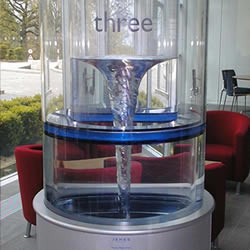
The final installation, called the Wessex Clock measures 3 metres tall and 500mm
in diameter. A pair of coaxial acrylic columns contain two separate volumes
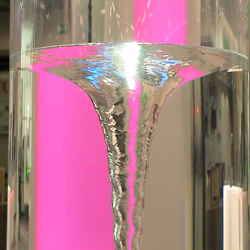
of water. The inner column contains the vortex, which varies in height according
to the minutes in the hour and fills over one hour. The volume of water in the
outer column, with a float on top, indicates the hour of the day and fills over
a twelve-hour period.
The inner column empties on the hour. At twelve noon, both columns empty together.
Lighting within the feature causes the water to sparkle at the top of the vortex.
At night, the lighting projects a further image on to the ceiling of the foyer.
This accurate time piece is controlled from the plant room below. Superb water
clarity is ensured by using fully deionised water, a UV steriliser, in-line
filters and environmentally friendly water treatment means. The plant is controlled
using a custom-built, microprocessor-driven management system - which has an
automatic ability to correct for winter/summer time changes. Maintenance signals
are provided to the main building management system.
WATER WALLS
This water wall uses copper, but it could be glass, acrylic, stone, or ceramic
- with or without a logo.
Features like this are well-suited to areas where space is limited. They can
be wall-mounted, or can stand alone.
SLATE FEATURE
This feature is underway for St John's Hospital in Bath.
It comprises a natural slate boulder which has been machined to hold a copper
font.
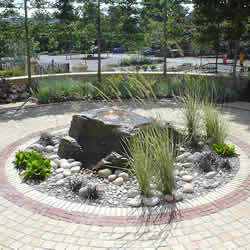
Water wells up in the font and flows over the boulder to the ground. Light,
too, flows with the water to enhance the effect.
LANTERN FEATURE
For a private client in Sussex we produced this small garden feature. A Victorian
gas lantern was adapted so that water could flow over its surface onto a slate-pebble
tray set in a rustic wood frame. The water falling onto the pebbles makes an
attractive and relaxing sound.
WHIRLPOOLS
Vortices are one of nature's most fascinating and dramatic creations. James
Designs has the experience and expertise to create vortices whirlpools
- in water features and to get them right. A beautiful natural phenomenon captured
in perfect form.
With a proven track record, James has developed the technology and designs over
a number of years to create and control vortices. Now, based on this experience,
we produce water features for both commercial and private clients for settings
in and out of doors.
Open or closed, single or multiple vortex displays can be created in a water
feature. We can produce perfectly-formed, air-bubble free, vortices of different
forms and have the unique skills to vary the height of vortices with time, creating
ever-changing displays which interact with natural and other sources of light.
We back up our creativity with excellent design, quality engineering, lighting
and appropriate control systems to ensure that the displays are attractive,
versatile and reliable. We design and can provide ongoing support for maintenance
programmes to ensure that the water clarity, vortices and their reflections
remain superb.The Wessex Clock is placed in the foyer of Wessex Waters
award-winning HQ in Bath. A two metre vortex rises and falls, indicating minutes
of time. It is contained within a second column, where a float moves with the
changing hours. Lighting in the display projects a constantly changing image
above the clock.
We produce vortex tubes, vortex globes, vortex clocks and other time-driven
displays. Vortex tubes can be produced in the range 100 to 600 mm diameter.
Vortex globes can be from 400 to 1200 mm diameter. We are constantly developing
new designs and forms.
Some of our work is shown here. Please contact us to discuss your feature.
ENGINEERING
Behind every installation is the reassurance of quality engineering and practical
know-how.
New projects involve research and development and often prototypes are developed
in the studio before full-scale pieces are progressed.
James Designs offer the back-up of a qualified chartered engineer experienced
in project management and the security of many years of experience in pioneering
architectural developments in fluid dynamics.
THE BRIEF
As well as the aesthetic and the creation of an exhilarating and even unique
water-based sculpture that will add a totally new dimension to your chosen location,
it is important for James Designs to assess the following practical considerations:
* Size and weight
* Design integration
* Materials (including durability, colour and finish)
* Electrical power supply
* Water supply, drainage, filtration, purification, evaporation, splashing,
overflow, noise, the effect of filling by rain and the risk of freezing
* Effects of air movement
* Lighting
* Safety and children
* Commissioning, operation and maintenance
* Feng Shui
* Planting (if any)
FENG SHUI
Feng Shui - literally "wind" and "water" - evolved into
a refined art from the simple observation that people are affected for good
or ill by their surroundings: the layout and orientation of their workplaces
and homes. The Chinese have long observed that some surroundings are better
or luckier than others. Every hill, building, hall, window and corner and the
ways in which they face wind and water have an effect. Improve the surroundings
and you improve the lives of the people living within them.
The goal of Feng Shui is complete harmony with the environment or "natural
order" which, when achieved, will bring prosperity, health and happiness.
Expressed another way, it is the art of achieving balance: it might even be
seen as the external equivalent of Acupuncture or Shiatsu. Just as these practices
aim to measure and balance energy flows within a person, Feng Shui aims to work
on the environment in which we live.
Feng Shui also works with the concepts of Yin and Yang. In simple terms, to
achieve one's full potential, it is essential to maintain a balance of Yin and
Yang. The concept of Yin and Yang is a metaphor to describe how everything functions
in relation to everything else... or perhaps in Isaac Newton's words: "to
every action there is an equal and opposite reaction".
All of nature is in a process of constant change, in effect flowing between
a state of Yin and Yang, night and day, cold and hot, stillness and movement,
empty and full, contraction and expansion.
To the Chinese the life force within everything, that flows between Yin and
Yang, is known as "Chi" and its movement is often represented by the
flow of water.
In Feng Shui, moving water is felt to be one of the most effective ways of increasing
the energy of a specific space or room or building. The sound and sight of running
water within water features is, therefore, not only pleasing to the senses,
but also provides a sense of movement, of energy, of life.
In the Yin Yang Fountain® the water moves in a cyclical fashion. This is
at the heart of the concept of Yin and Yang in which everything is regarded
as being in a constant state of flux. Still water is Yin compared to moving
water, which is Yang. One chamber fills whilst the other empties.
Yin flowing to Yang; Yang flowing to Yin.
Clearly, there is useful synergy between the application of water fountains
or features and the art of Feng Shui. At a simple level, it is surely agreed
that water fountains bring pleasure and an improvement to their surroundings.
If it is desired to follow the methods of Feng Shui, then the integration of
water features can be achieved in sympathy with its ways.
In business, Feng Shui has been practised in Taiwan, Hong Kong and Singapore
for a long time and is now increasingly being used in America and the United
Kingdom.
MISTING WEIR
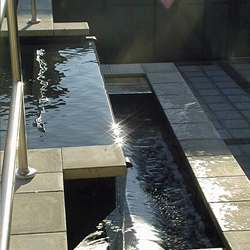
This shallow tension pool, with Corian weirs, creates a glass-like waterfall which falls into an uplit reservoir. The rippling and misting fountains produce swirls of vapour that play in the wind. The lower weir creates further water displays.
Produced for The Freeways Trust in Bristol in conjunction with Michael Axford Chartered Architects.
CONTACT
James Designs UK
James Designs
The Old Tannery
Kelston
Bath
BA1 9AN
Tel: +44 (0) 117 902 0200
Fax: +44 (0) 117 902 0201
JAMES COLEMAN
*
Designer and Chartered Engineer.
* Producer of water features and consultant in fluid mechanics.
* Originator and holder of patents and design registrations both in the UK and
abroad.
* Member of the Institute of Mechanical Engineers, The Fountain Society and
The Concrete Society.
NESTA
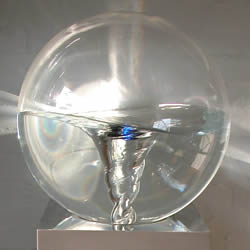
This vortex globe water feature has been designed and engineered for NESTA,
the National Endowment for Science Technology and The Arts.
A bespoke, 800 mm diameter, acrylic globe stands on the bead-blasted stainless
steel plinth which is polished to a mirror finish on the top. The vortex is
generated by the tuned application of a pump and nozzles forming inlets and
an outlet. The water is always in a state of flux – a balance between
the pumped flow and the effects of vortical motion under the influence of gravity.
The movement of people in the offices is sensed by the custom-built microprocessor
which drives the vortex through a feedback control system. The intelligent software
learns how to react on a daily basis. Three vortex control programs are provided.
The vortex rises to fill the globe. As it rises, its reflection is seen in
the mirrored surface of the plinth, adding another dimension to the feature.
Lighting, projected through the vortex, creates an ever-changing display above
the globe. The globe, when full, holds about 250 litres of water which must
be crystal-clear at all times. This is ensured by using fully deionised water
and a bypass recirculation loop with UV steriliser, in-line filters and environmentally-friendly
water treatment means. The whole volume of water is contained in two linked
tanks.
Simon Tegala, a NESTA Fellow, commissioned the work having proposed that the
intensity of a vortex of water should reflect the movement of people within
the NESTA offices. He suggested that by having movement sensors across the space
it would be possible to control the vortex.
The technology that is embodied within this water feature is unique and the
designs and processes behind it are protected by patent applications.
Goto:
Home Vortex Clock Slate Feature Water Walls Lantern Feature Feng Shui Engineering NESTA Contact James Coleman Practicalities Whirlpools Misting Weir Commissions